
Why is Amazon’s recommendation engine often called the most valuable in ecommerce? Because a single feature — “customers who bought this also bought” and its many descendants — is estimated to drive a huge share of the company’s sales. It’s the clearest proof that recommendation AI isn’t a nice-to-have; it’s a revenue engine.
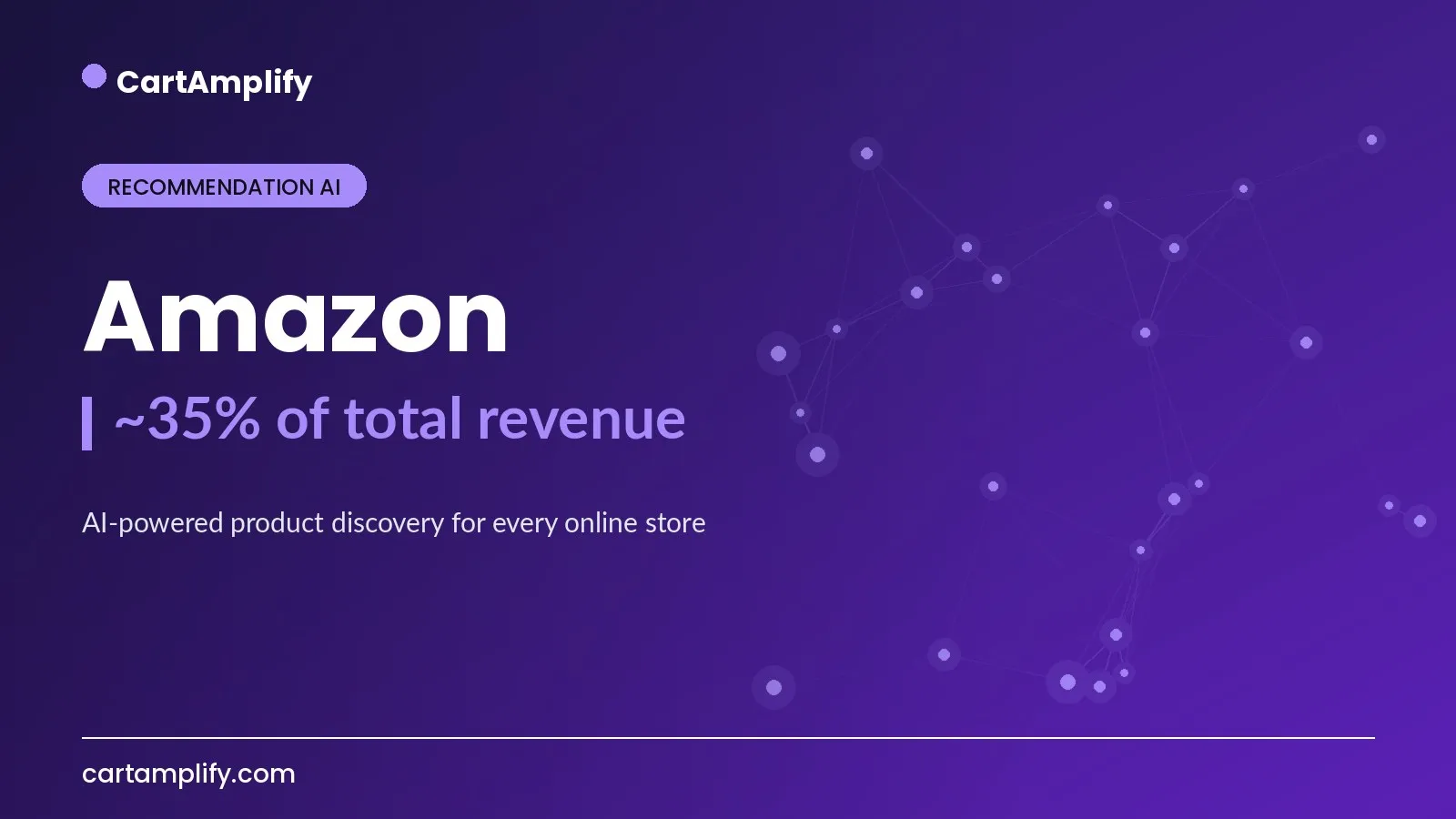
The pattern: Amazon’s AI recommendation engine is widely estimated to generate around 35% of the company’s total revenue — among the most successful product recommendation systems in ecommerce.
Recommendations as a primary revenue channel#
Most stores treat recommendations as a garnish — a row at the bottom of a page. Amazon treats them as core infrastructure, woven through the homepage, product pages, cart, and email. The cumulative effect is that a large share of what shoppers buy is something the engine surfaced, not something they originally came for. When roughly a third of revenue traces to recommendations, the engine isn’t supporting the store — it largely is the store.
How recommendation AI works#
Recommendation AI learns from collective behavior: it maps which products go together by observing what real shoppers view and buy, then predicts the next item each individual is most likely to want.
Three mechanics make Amazon’s engine so effective. It surfaces recommendations everywhere — homepage, product pages, cart, email — so there’s always a relevant next product in view. It drives complementary discovery, surfacing the items that pair with what a shopper is considering, which grows basket size. And it learns continuously from billions of interactions, so every purchase sharpens the next recommendation.
Why ubiquity is the lesson#
The reason Amazon’s recommendations drive so much revenue isn’t a single clever algorithm — it’s that recommendations appear at every step of the journey, each one relevant to the moment. A shopper is never more than a glance away from a product they’re likely to want. That ubiquity, combined with relevance, is what compounds into ~35% of revenue.
The takeaway for any store: recommendations shouldn’t live in one widget. The stores that capture the most value place relevant recommendations throughout the journey — and let the engine learn from every interaction.
What this means for your store#
You’ll never match Amazon’s scale, but you can match its approach:
- Place recommendations throughout the journey — homepage, product, cart, email — not in one isolated row.
- Surface complementary products to grow basket size at the right moments.
- Let the engine learn continuously so recommendations improve automatically.
Recommendation AI can be one of your largest revenue channels — if you treat it like one.
Bring recommendation AI to your store with CartAmplify#
CartAmplify brings Amazon-style recommendation AI to any store — Shopify, dropshipping, or marketplace. Relevant recommendations throughout the journey that turn into a primary revenue channel.
Related reading#
- How Amazon’s AI Updates Prices 2.5 Million Times a Day
- How Zalando Lifts High-Value Interactions 40% with Recommendation AI
The ~35% figure is a widely cited industry estimate; Amazon does not publish an official figure. Results vary by catalog, traffic, and implementation.