
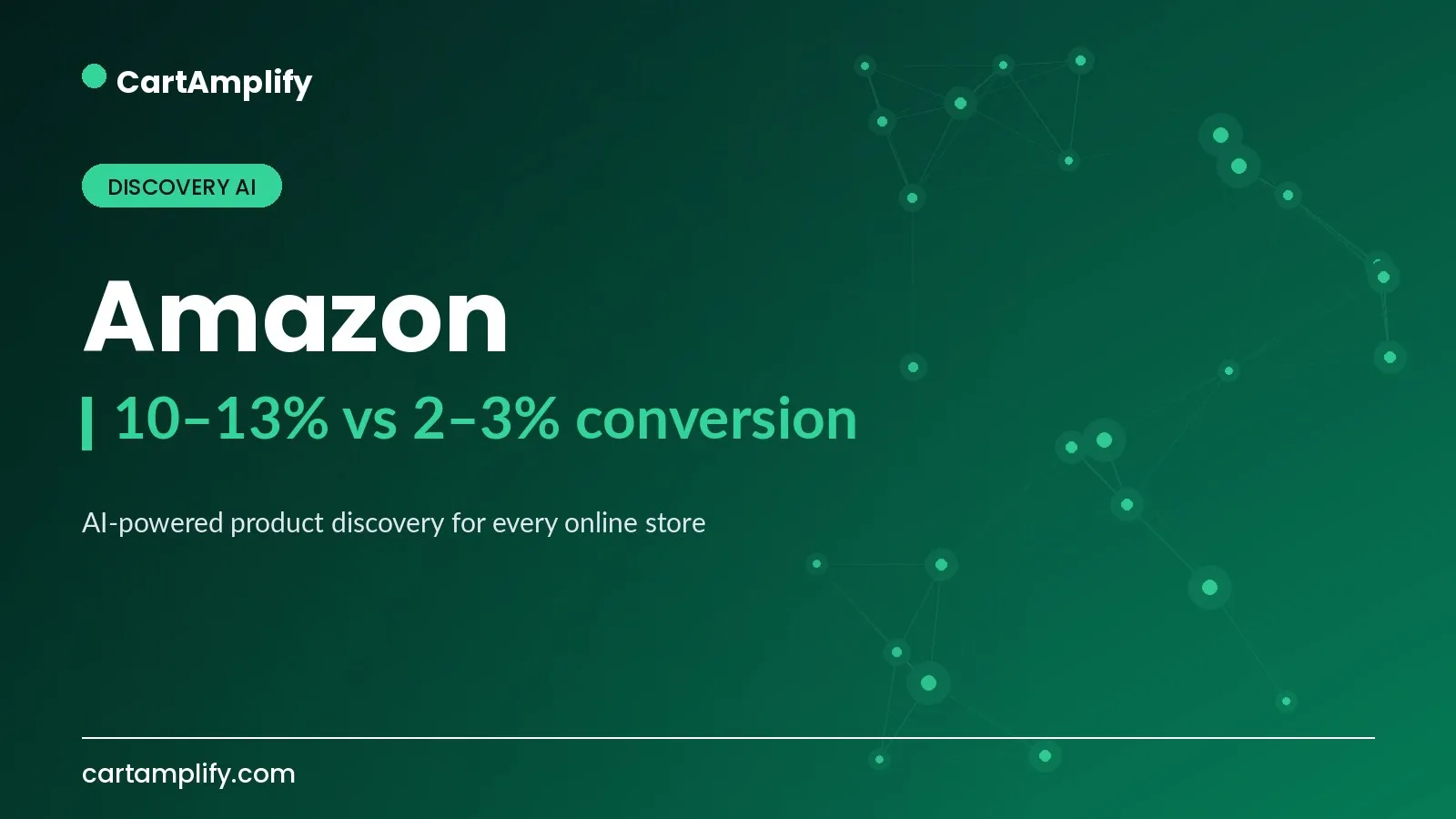
Why does Amazon convert at a multiple of what most stores manage? Because every surface a shopper sees is ranked by one question: how likely is this person to buy this product? That relentless focus on predicted purchase probability is the engine behind conversion rates far above the norm.
The result: Amazon’s AI-powered product discovery contributes to a dominant 10–13% conversion rate — far above the 2–3% industry average — by ranking products based on predicted purchase probability.
Ranking by purchase probability#
Most stores rank products by rough proxies — popularity, recency, manual merchandising. Amazon ranks by a sharper question: which product is this specific shopper most likely to buy right now? Every recommendation row, search result, and browse feed is ordered by predicted purchase probability, so the items most likely to convert sit where the shopper looks first. Applied across the entire journey, that discipline compounds into conversion rates several times the industry average.
The gap between 2–3% and 10–13% isn’t magic — it’s the cumulative effect of always surfacing the highest-probability product.
How discovery AI works#
Discovery AI personalizes what each shopper sees based on behavior and predicted intent. Amazon’s version optimizes everything toward purchase probability.
Three mechanics drive it. The engine predicts purchase probability for each shopper-product pair, drawing on vast behavioral data. It ranks by that probability, ordering every surface so the most likely purchase leads. And it learns continuously, sharpening predictions from billions of interactions.
Why probability-based ranking wins#
The lesson is that how you rank matters as much as what you show. Two stores with the same catalog convert very differently depending on the order products appear in. Ranking by predicted purchase probability — rather than popularity or manual rules — puts the right product in front of each shopper at each moment, and that ordering decision, repeated across millions of interactions, is what separates a 3% store from a 13% one. Relevance isn’t just selection; it’s sequence.
What this means for your store#
You won’t match Amazon’s data, but you can adopt its principle:
- Rank products by predicted purchase probability for each shopper, not by popularity or fixed rules.
- Apply that ranking everywhere — search, browse, recommendations — not in one widget.
- Let the system learn from outcomes so predictions sharpen over time.
The order products appear in is a conversion lever most stores ignore. Probability-based ranking is how the best stores pull it.
Bring discovery AI to your store with CartAmplify#
CartAmplify brings purchase-probability-based discovery AI to any store — Shopify, dropshipping, or marketplace. Rank every surface around what each shopper is most likely to buy, the way Amazon converts far above average.
Related reading#
- How Amazon’s AI Updates Prices 2.5 Million Times a Day
- How ASOS Lifts Email Engagement 75% with AI Discovery
The 10–13% vs 2–3% figures are widely cited industry estimates; Amazon does not publish an official conversion rate. Results vary by catalog, traffic, and implementation.